
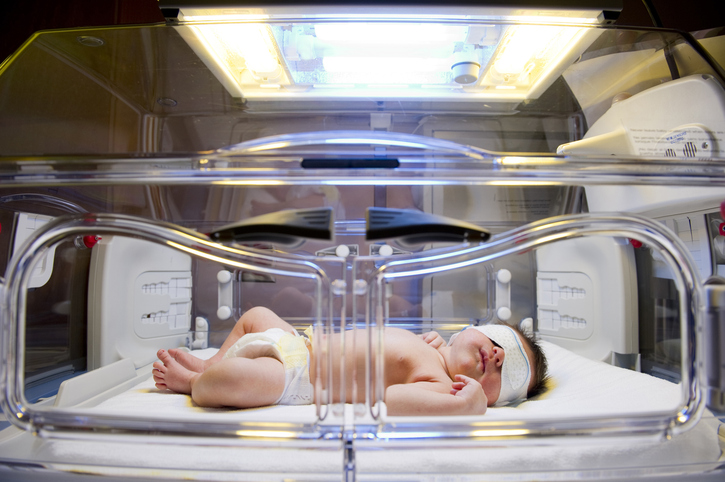
JaundiceJaundice A common symptom of HDFN, jaundice is caused by excess bilirubin and is characterized by a yellow tint to the skin or eyes., also known as hyperbilirubinemiaHyperbilirubinemia A common cause of jaundice, this refers to higher than normal bilirubin levels in the blood., is common in newborns, particularly in preterm babies. It can also be a sign of other conditions, such as hemolytic disease of the fetus and newborn (HDFN), liver problems, infection or low oxygen levels.
Caused by high levels of bilirubinBilirubin A yellow substance produced when red blood cells break down. High bilirubin levels in newborns with HDFN can cause jaundice or, in severe cases, brain damage. in the blood, jaundice often occurs in one to three days following birth and can take a few days to a few weeks to disappear entirely. PhototherapyPhototherapy A treatment that uses special blue light to help newborns break down bilirubin and prevent kernicterus. is administered to break down the bilirubin in the blood, followed by blood transfusions, depending on the severity of symptoms.
What is HDFN?
Hemolytic disease of the fetus and newborn (HDFN) is an immune-mediated red blood cell (RBC) disorder that occurs when a baby’s RBCs break down quickly, which is called hemolysis. HDFN is caused by a mismatch between a mother’s and her baby’s blood type (A, B, AB, or O) or Rhesus (RhRh factor A protein or antigen found on red blood cells. When an Rh-negative mother carries an Rh-positive fetus, her immune system may make antibodies that attack the fetus' red blood cells.) factor (Rh-positiveRh-Positive A blood type trait that means your red blood cells have the Rh(D) antigen. or Rh-negativeRh-Negative A blood type trait that means your red blood cells lack the Rh(D) antigen.) during pregnancy. Numerous antibodiesAntibody A protein made by the immune system that recognizes and attacks foreign substances, such as bacteria, or in HDFN, fetal red blood cells carrying incompatible antigens. to RBC antigensAntibody A protein made by the immune system that recognizes and attacks foreign substances, such as bacteria, or in HDFN, fetal red blood cells carrying incompatible antigens. can be linked to HDFN, such as those from the ABO and Rh blood groupBlood group A classification of blood based on inherited markers found on red blood cells. The ABO and Rh blood groups are most common in HDFN. systems.
What is bilirubin?
Bilirubin is a yellowish pigment that occurs in the blood when red blood cells break down. It then passes through the liver to be processed and then eliminated from the body. However, in newborns, the liver is not fully developed and is not able to process the bilirubin. It therefore accumulates in the blood, giving a yellowish tint to the baby’s skin and whites of the eyes.
What is the risk of untreated jaundice?
If jaundice is not effectively treated and bilirubin levels in the blood continue to rise, the consequences can be life-threatening. Kernicterus is a serious complication of jaundice in babies that occurs in rare cases, when the bilirubin crosses the blood-brain barrier. It can damage the spinal cord and brain, causing brain damage and death.
How are bilirubin levels checked?
There are several ways to check an infant’s bilirubin levels. One of the most common ways is through a blood test, which requires a small amount of blood from the baby. This is often performed by pricking the infant’s heel.
Doctors may also use a transcutaneous bilirubinometer–a device that measures bilirubin levels by shining a light on a baby’s skin, typically on their forehead.
Treatment of jaundice in newborns
Not all cases of jaundice are a cause for alarm, with many newborns recovering without treatment. If bilirubin levels are within safe levels, or up to 17-18 mg/dl, extra feedings and fluids are recommended to eliminate the bilirubin.
If bilirubin levels are not falling or they are increasing up to 0 mg/dl, which is considered dangerous, a treatment will be required. Phototherapy is standard first-line treatment and involves placing the newborn under blue light. This light therapy breaks down the bilirubin levels in the blood. Initially, the newborn’s blood will be tested every four to six hours to see if the treatment is working. As the levels start to fall, bilirubin levels will be checked every six to 12 hours.
In cases where bilirubin levels are still rising, intravenous immunoglobulin (IVIG) is the next stage of treatment. If this is not effective, an exchange blood transfusion may be necessary as an emergency measure. This procedure replaces the baby’s blood with a donor’s blood, and bilirubin levels should fall rapidly.
In most cases of neonatal jaundice, bilirubin levels will usually stabilize, and jaundice disappear, within two weeks. In premature babies or babies who are solely breastfed, it may take up to two to three weeks, but the risk of this is low.

