Neonatal jaundice is commonly observed in newborns, with approximately 60% of full-term newborns and 80% of preterm newborns experiencing jaundice in the first week of life.
It can vary in severity and usually responds well to treatment, namely phototherapy. However, in some rare cases, “Bronze Baby” syndrome can occur as a complication of exposure to the light during phototherapy.
What is jaundice?
Jaundice is the yellowing of the baby’s skin and the whites of the eyes. Onset is usually quite rapid post-delivery, often 24-36 hours following birth. It occurs when bilirubin levels in the newborn’s blood become elevated. In most cases, jaundice is mild, and no treatment is required, and it resolves with the help of adequate feeding. However, some newborns – in particular preterm babies – have difficulty breaking the bilirubin down and eliminating it from their blood, as their livers are too immature. For example, babies born with hemolytic disease of the fetus and newborn (HDFN) typically exhibit jaundice.
What is HDFN?
Hemolytic disease of the fetus and newborn (HDFN) is an immune-mediated red blood cell (RBC) disorder that occurs when a baby’s RBCs break down quickly, which is called hemolysis. HDFN is caused by a mismatch between a mother’s and her baby’s blood type (A, B, AB, or O) or Rhesus (Rh) factor (Rh-positive or Rh-negative) during pregnancy. Numerous antibodies to RBC antigens can be linked to HDFN, such as those from the ABO and Rh blood group systems.
If left untreated, jaundice can have severe consequences, including kernicterus which can cause permanent brain damage, deafness and seizures. Treatment starts with phototherapy and then if bilirubin levels do not drop, an exchange transfusion may need to be considered.
Learn more about HDFN treatment and care
Phototherapy
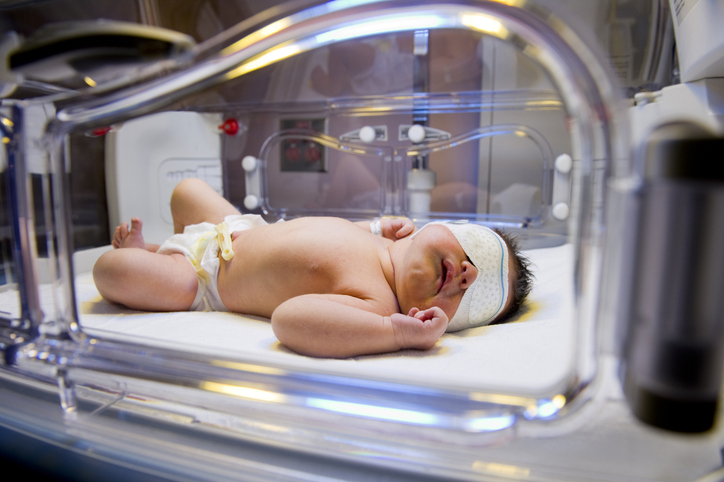
Phototherapy is the main treatment of neonatal jaundice and in most cases, symptoms disappear in a matter of days. The baby is placed under a special blue light, with their eyes covered to avoid retinal damage. It safely breaks down the bilirubin in the newborn’s blood and so it can be eliminated via the baby’s stool and urine.
Minor side effects of phototherapy include diarrhea, water loss from the skin and in rare cases, “Bronze Baby” syndrome has been observed.
“Bronze Baby” syndrome
A rare and unpredictable complication of phototherapy, “Bronze Baby” syndrome is characterized by a gray-brown discoloration of the skin following exposure to phototherapy. The discontinuation of phototherapy is usually recommended and if the jaundice doesn’t resolve, another treatment may be required, such as an exchange transfusion. Skin discoloration usually disappears in the following days and weeks.
While “Bronze Baby” syndrome is usually mild, with no lasting side effects, it may indicate an underlying liver disorder, such as cholestasis that requires further investigation. In most cases, once the light therapy is stopped, the bronze or brown-gray skin color starts to fade.