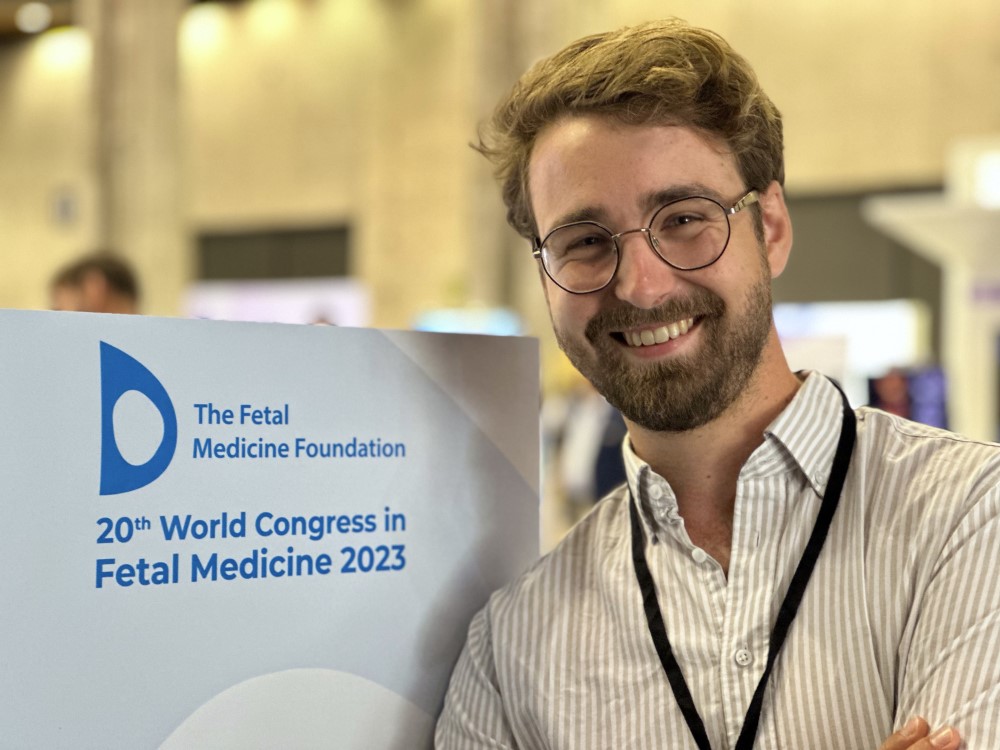
VALENCIA, Spain—In ancient Greek mythology, Dionysus is the god of wine and ecstasy. And throughout the New Testament, wine represents the blood of Jesus Christ.
But now, the name has medical significance too. DIONYSUS is a Netherlands-based registry whose acronym stands for “worlDwIde cOllaboratioN for hemolYtic diSease of the fetUS and newborn.” Also known as Rhesus disease, hemolytic disease of the fetus and newborn (HDFN) arises when would-be mothers have a blood type that’s incompatible with that of their unborn child, with potentially fatal consequences.
That’s why the need for such a registry is so urgent, said its coordinator, Derek de Winter, M.D., of Leiden University Medical Center in the Netherlands.
A collaboration between Leiden and Sanquin—an Amsterdam-based nonprofit that promotes blood donations—DIONYSUS is the result of ideas developed in June 2021 by a pair of Dutch researchers: neonatologist Enrico Lopriore and obstetrician-gynecologist Joanne Verweij.
“We are the only center in the Netherlands focusing on this disease. We have a well-established screening program, but we’re just a small speck on the global map,” Dr. De Winter said during the Fetal Medicine Foundation’s 20th World Congress here earlier this year. “We wanted to see what other centers in the world are doing. We don’t really know what’s happening outside our borders.”
So far, DIONYSUS has 31 centers in 22 countries. Most are in Europe, with participants also in South America, Africa, Asia, and North America. US centers include The Mother Baby Center at Abbott Northwestern and Children’s Minnesota in Minneapolis; Children’s Memorial Hermann Hospital, Houston Texas; and Levine Children’s Hospital, Charlotte, North Carolina. Other non-European centers include Sheba Medical Center in Tel Aviv, Israel; China’s Shanghai First Maternity & Infant Hospital; Stellenbosch University in Cape Town, South Africa; and Hospital de la Mujer in La Paz, Bolivia.
Thanks to DIONYSUS, investigators have already amassed data on the largest cohort of HDFN patients ever collected. About 2310 cases have been recorded, of which more than 1200 were treated prenatally—for example, with intrauterine transfusions—900 cases were not treated prenatally, and about 90 cases resulted in fetal demise or death within the first few months of the baby’s life.
Potential New Therapy Offers Hope
Dr. De Winter said something that really surprised him was the frequency of exchange transfusions at some of the centers participating in the study.
“We didn’t expect it to be this high,” he said of the procedure, in which blood is taken from the baby and is replaced with donor blood in order to treat severe hyperbilirubinemia, or jaundice.
“That is just to get rid of the toxic wastes that result from the destruction of red blood cells through those antibodies,” Dr. De Winter explained. “It’s a procedure that was very commonly done 60 years ago and was the primary treatment type for this disease.”
But since the late 1960s, phototherapy has been accepted as the first-line treatment for jaundice, and has notably decreased the need for exchange transfusions.
Even so, Peter Lindgren, MD, president of the Swedish-based International Fetal Medicine and Surgery Society, said the disease still presents a very real threat.
“If the mother is Rh-D negative and she has a child with a man who’s Rh-D positive, there’s a huge risk the fetus will have the same blood type as the father,” said Dr. Lindgren, a surgeon at Karolinska University Hospital in Stockholm. “That’s normally not a big issue, especially during the first pregnancy. But when blood connects the fetus and mother, the mother will start to build up antibodies—and these antibodies will be there for life. So if she gets pregnant a second time with the same father, there’s a huge risk the fetus will be anemic.”
One bright spot is nipocalimab, an investigational therapy developed by Janssen, a division of Johnson & Johnson. This monoclonal antibody is believed to selectively block FcRn to reduce levels of circulating immunoglobulin G (IgG) antibodies, including autoantibodies and alloantibodies that underlie multiple conditions.
In a proof-of-concept phase 2 trial whose results were announced earlier this year, 92% of pregnancies treated with nipocalimab resulted in live births, with 54% delivering at or after 32 weeks without intrauterine transfusions.
A Focus on Developing Countries
HFDN remains a problem in wealthy countries, but more so throughout the developing world, particularly in Africa. Each year, the disease causes an estimated 50,000 deaths worldwide.

The reality is that 90% of clinically approved therapies lack appropriate labeling information for pregnancy and lactation, while only 9 drugs are approved and sold for use in obstetric indications, said Kattayoun Kordy, MD, senior director of rare disease clinical development/immunology at Janssen.
“Historically, pregnant women have been excluded from clinical trials, and you can’t get pregnant during these studies,” she said, estimating that only 50 or so phase 2 trials are now underway for pregnancy complications.
A pediatric gastroenterologist and clinical pharmacologist who’s worked extensively in Africa to deliver HIV clinical care, Dr. Kordy said the paucity of clinical trials among pregnant women is mainly to blame for the lack of new approaches to treat HDFN over the years.
“In our study, we managed to get one center from South Africa onboard, but we wanted to focus on the other countries as well,” Dr. De Winter said. “For that reason, we reached out to gynecologists and pediatricians in Malawi, Ethiopia, and Tanzania, to see if they were also willing to undertake a research project that would focus on HDFN in those areas.”
Dr. De Winter said he’s currently gathering data from all centers involved in the project and will release a preliminary report by the end of 2023.
“We now have a large database that focuses on the current treatment types,” he said. “It’s important to know that this a rare disease, and that international collaboration is very important in rare diseases, so we can compare what we do and see what the clinical outcomes are.”